June 20, 2026
How I Saved My Doctor Father 1400+ Hours With AI
Earlier this year, I visited my father in China and found him doing something painful: typing personal Traditional Chinese Medicine (TCM) notes into Word documents by hand.
He is a TCM doctor with over three decades of experience. He had collected books and notes that were useful in practice but trapped on paper. In TCM, knowledge is not only learned from published materials. A lot of useful knowledge still moves through apprenticeship and shared semi-privately, through secretly kept handwritten notes and years of pattern recognition. My father’s corpus was often scattered across books, notes, and memory.
What he really wanted was a personal AI assistant that understood his own notes. None of the consumer-grade AI apps satisfied his needs, so I tried to build him something similar.
The first demo was just Claude Code in a folder
As the initial champion for Claude Code usage inside Quora, I immediately recognized that this was something agents could help with.
I asked my father for three Word documents he had already typed. I opened a terminal, pointed Claude Code at the folder, and asked the kind of question he would usually search for by memory: How do you treat a cold?
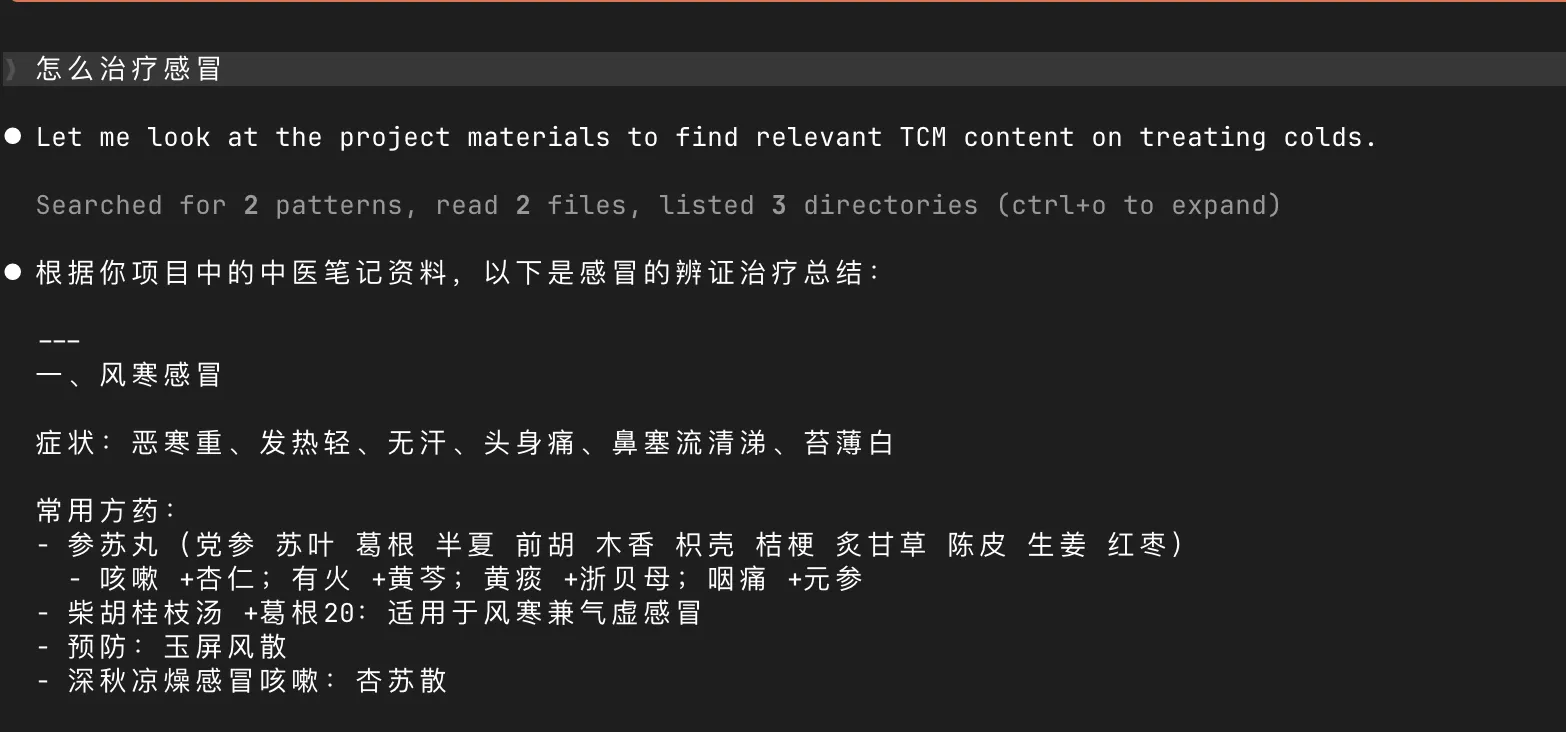
He didn’t expect much from the black terminal window. After all, DeepSeek and Doubao didn’t do a good job of answering basic medical questions. Then Claude Code started pulling together an answer from his own notes, and that was the first time he looked at the thing differently.
The demo was not a product
The terminal demo worked because I was there to operate it, but there’s a huge gap between me helping my father use AI and him being able to use it without me sitting next to him:
- As a non-technical user, my father was not going to use a terminal or write detailed LLM prompts.
- Digitizing decades of medical material correctly would be the biggest bottleneck. Claude could search text, but most of his knowledge was not text yet. It was in books and notes.
- Existing Chinese AI apps like DeepSeek had unsatisfying OCR quality, and could not handle a bursty load of hundreds of image OCR requests. Chat is also not a natural interface for reviewing OCR results.
- TCM doctors don’t want to have their private knowledge used for LLM training, and my personal Claude Code didn’t have Zero Data Retention.
- A busy doctor would want mobile access to an AI assistant, and the demo was desktop-only.
#2 was obviously the most burning problem. So instead of jumping into an AI assistant app, I started with OCR.
Reliability became the product
I picked Gemini 3 Pro as the initial OCR model and quickly coded up a version hosted on Cloudflare. The first constraints were:
- The app would handle a bursty load of 100+ images at the same time
- A better UI to review the OCR results
- A much better OCR quality thanks to Gemini’s multi-modality capability
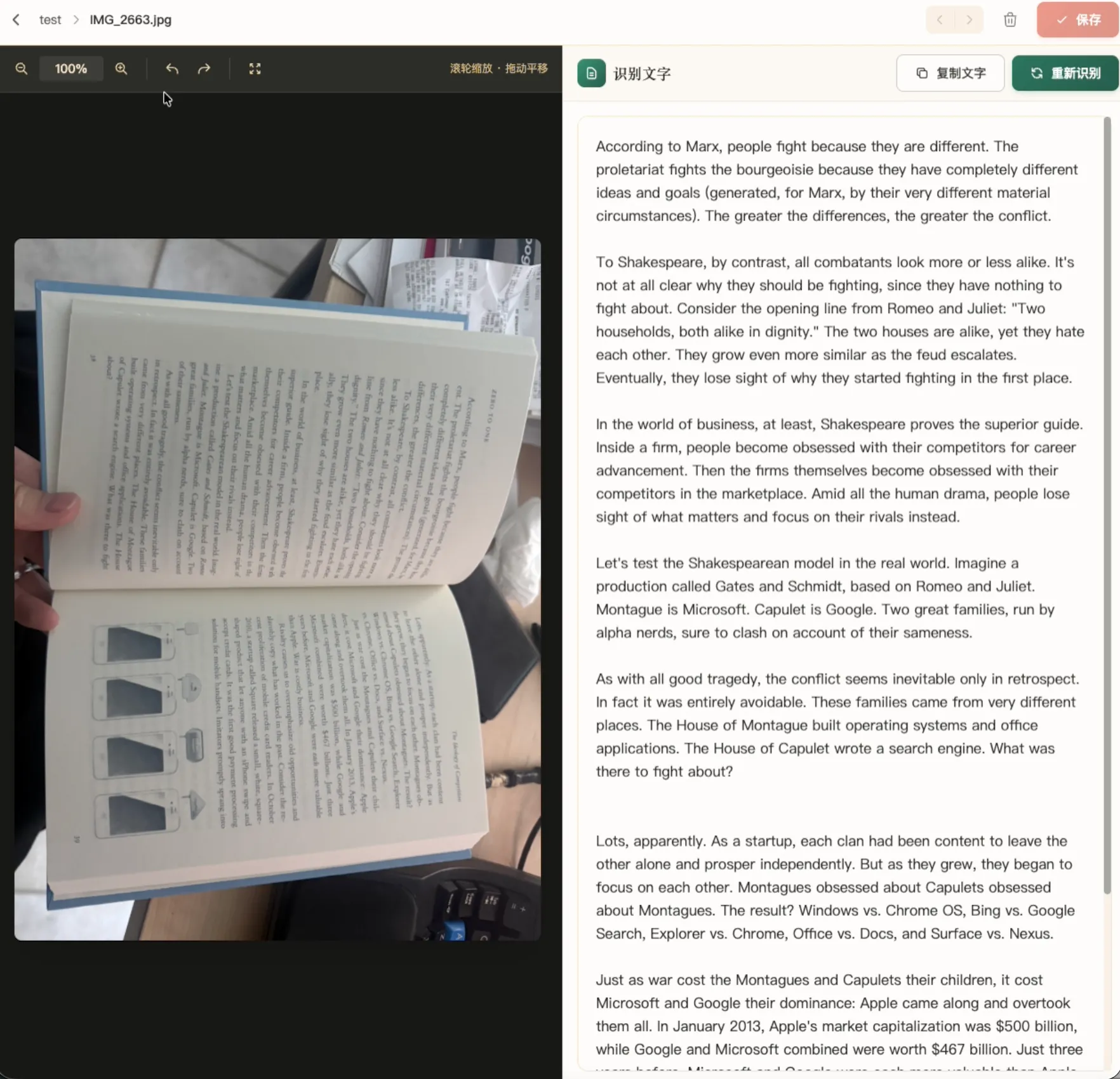
Although the OCR quality was exciting, this version had worse upload reliability than GitHub’s infamous uptime (<50%). Since Cloudflare IPs are heavily impacted by Chinese regulations and they only allowed me to host services in Japan, the upload reliability could be as low as ZERO! A 50-page book upload creates 50 chances for the app to lose my father’s trust.
After countless deep research sessions with ChatGPT and Claude, I migrated the whole backend infra to AWS Hong Kong.
This was an action I would never have taken before 2026. AI agents helped with two big chunks of engineering work I normally find slow:
- Surveying options. I compared Vercel, Azure, Alibaba Cloud, Tencent Cloud, Modal, and AWS, looking for the availability & pricing of the same boring primitives: object storage, message queue, serverless workers, database, secrets, observability, and a region close enough to the user.
- Migration. Claude Code made the rewrite fast enough to attempt for a one-user product, especially when you give it access to the production environment (probably don’t do this for a serious engineering product).
The usage spike
After the migration, reliability stopped being a problem, and my father started using the app daily. The next breakthrough came from listening to his feedback. He’d say things like: “I don’t know which pages I already checked,” and “how do I know this book is done?”
The review queue was built to address that problem, as shown in the following screenshot. I didn’t come up with this feature on my own, and my father didn’t ask for it either. My work experience at Quora helped me translate his needs into this review queue pattern quickly.
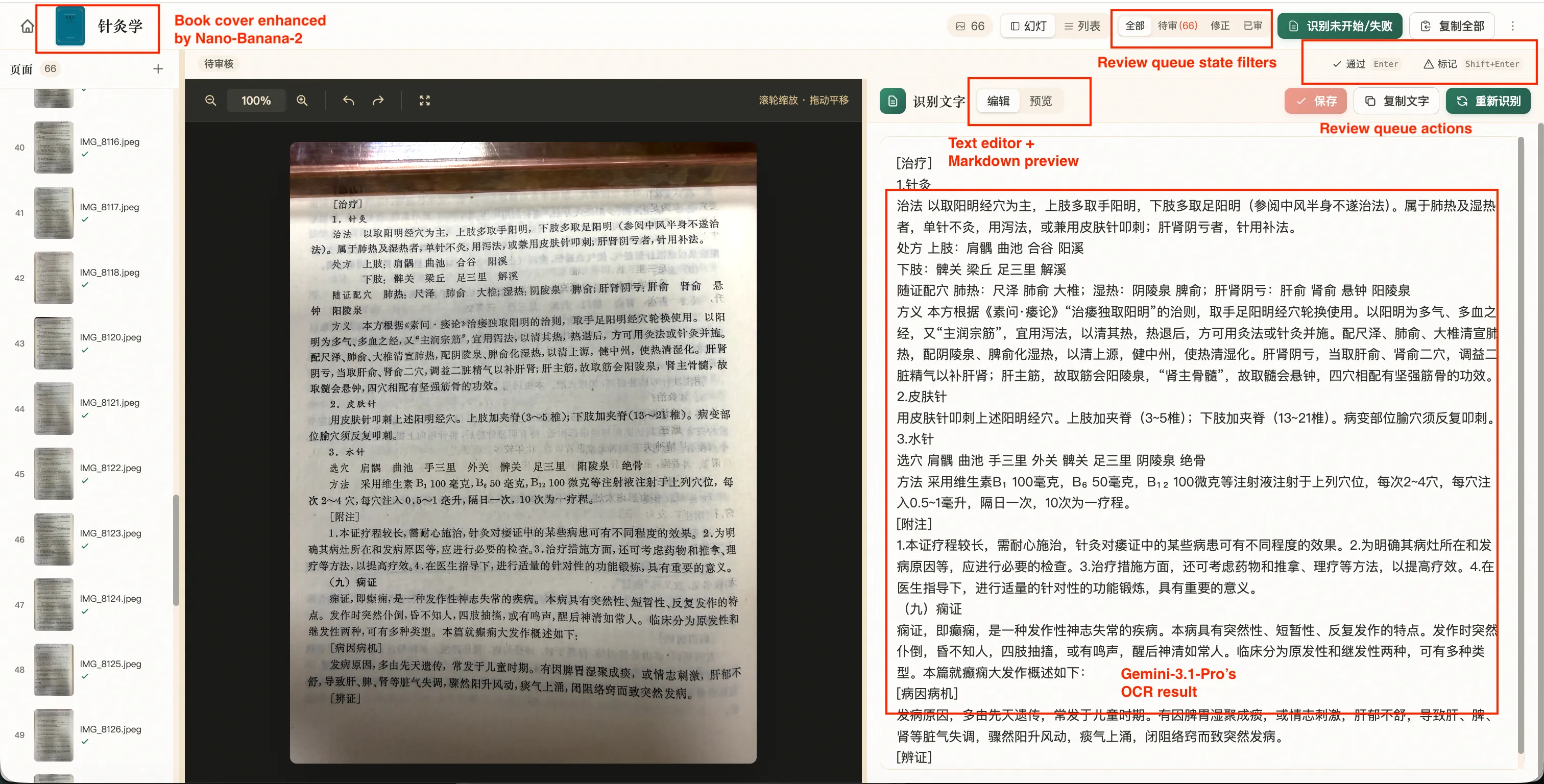
Each page got a simple state: waiting, needs correction, or reviewed. The UI showed the scanned page on one side and editable OCR text on the other. He could approve a page, flag it, fix the text, or re-run OCR without leaving the workflow. This feature also helped build trust with my father. After he saw a book with 90%+ first-pass OCR accuracy, he started to upload more, and even purchased a scanning accessory to help him scan pages faster.
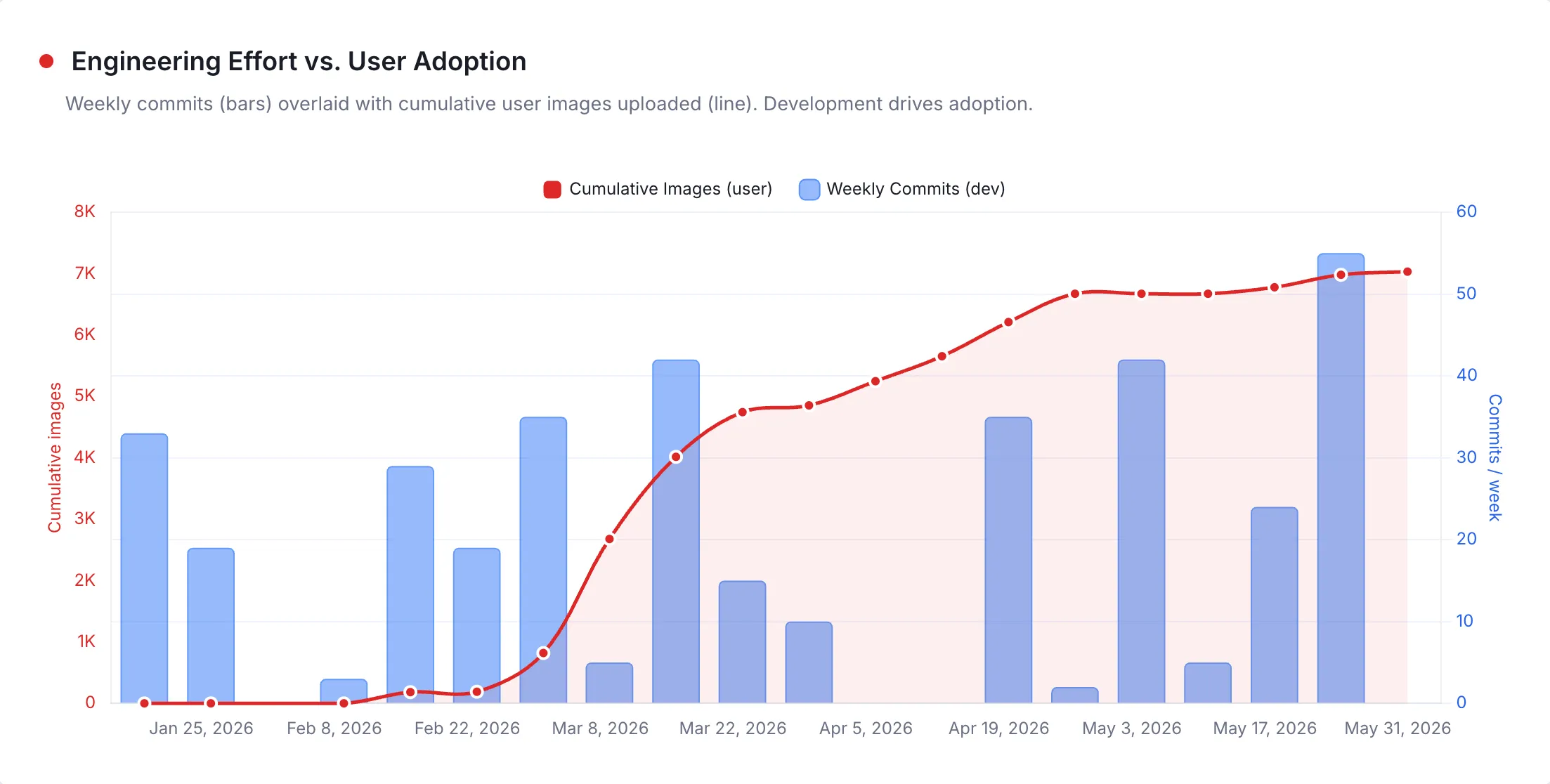
The usage took off in late February and early March:
The AI Assistant
The assistant was the feature I wanted to build on day one. But it would have been useless without a smooth OCR workflow first.
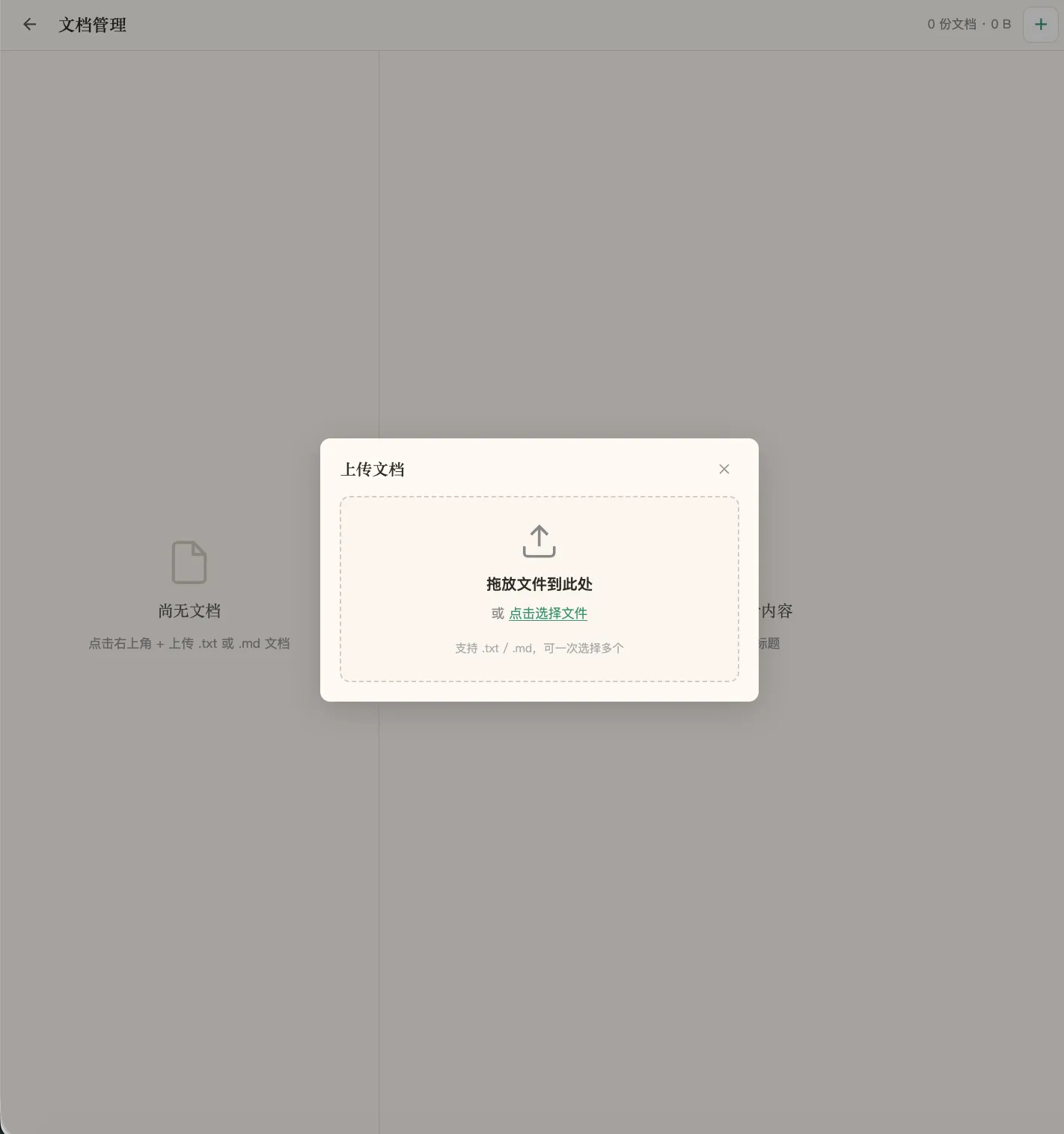
What I built was basically the terminal demo, but packaged for a non-technical doctor. He can upload or select documents, ask a question in Chinese, and watch the agent search through the material.
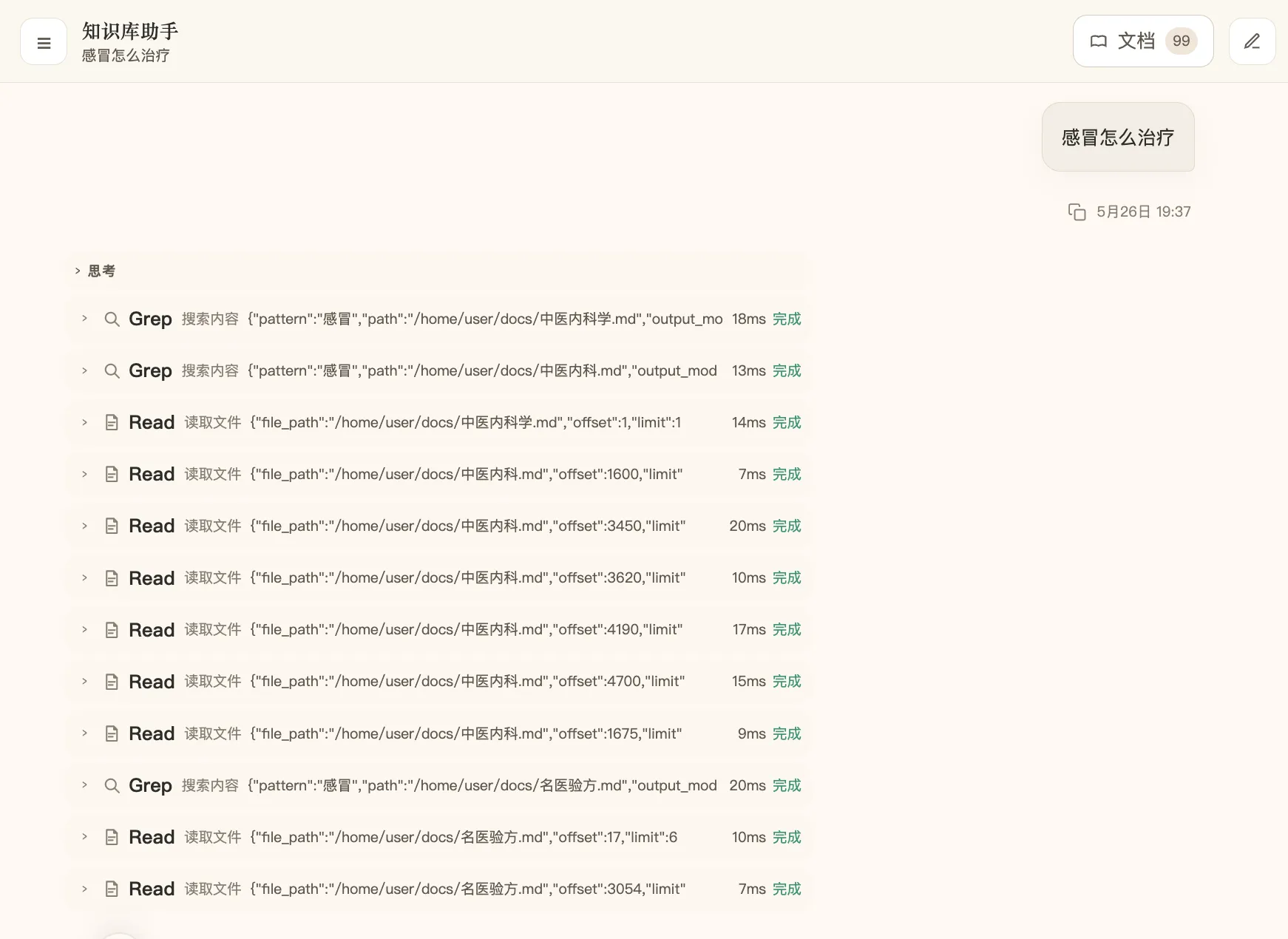
Under the hood, the app runs the Claude Agent SDK inside an E2B sandbox. For each run, it copies the selected markdown documents into the sandbox, lets the agent use tools like Grep and Read, and streams the tool trace back to the browser.
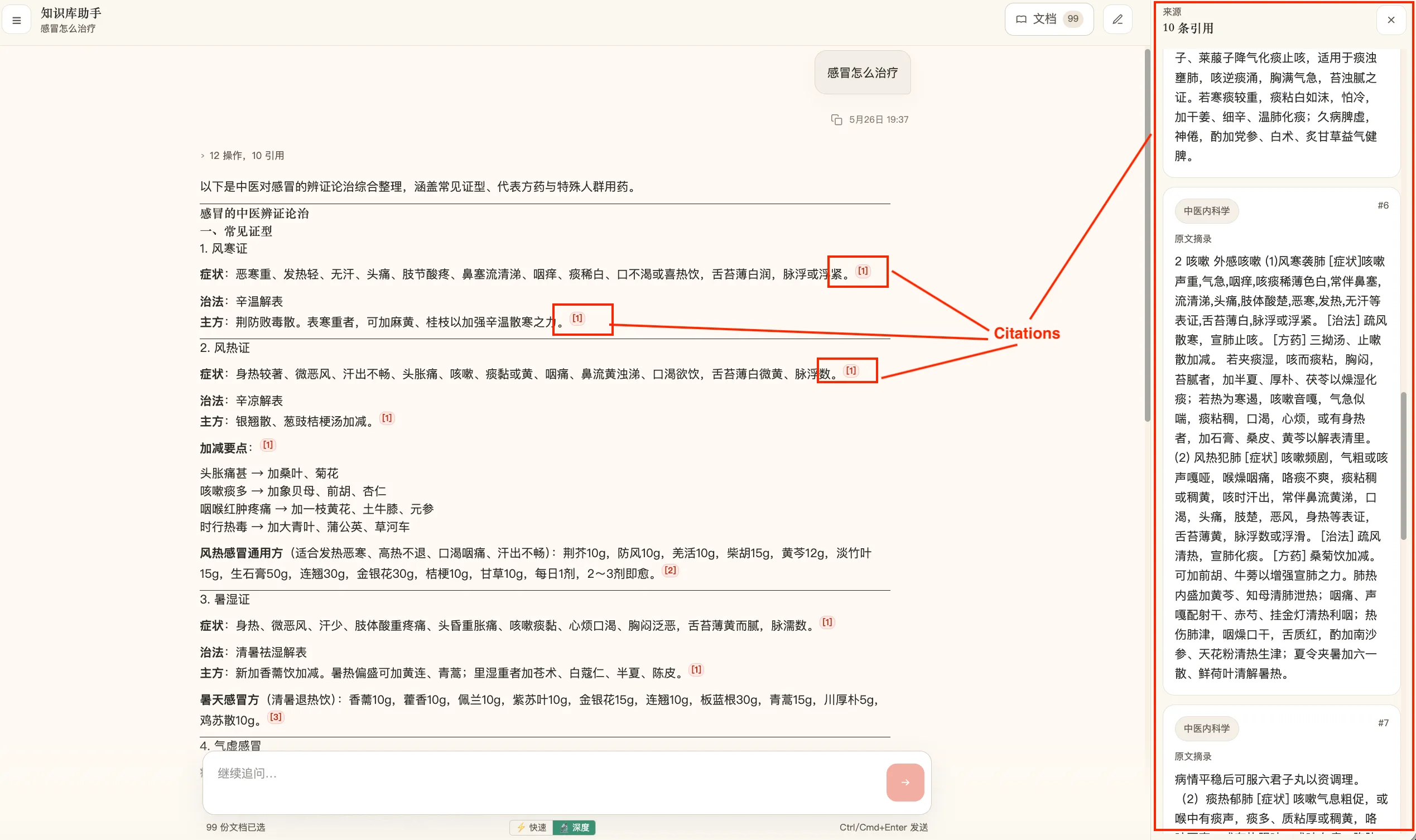
For medical work, my father needed to know where an answer came from. When the agent reads documents, the app turns passages into evidence. When the final answer cites it, the UI can show the source passage beside the answer.
Forward-Deployed Personal Software
The app only has one user. That sounds small until you count the time it saved.
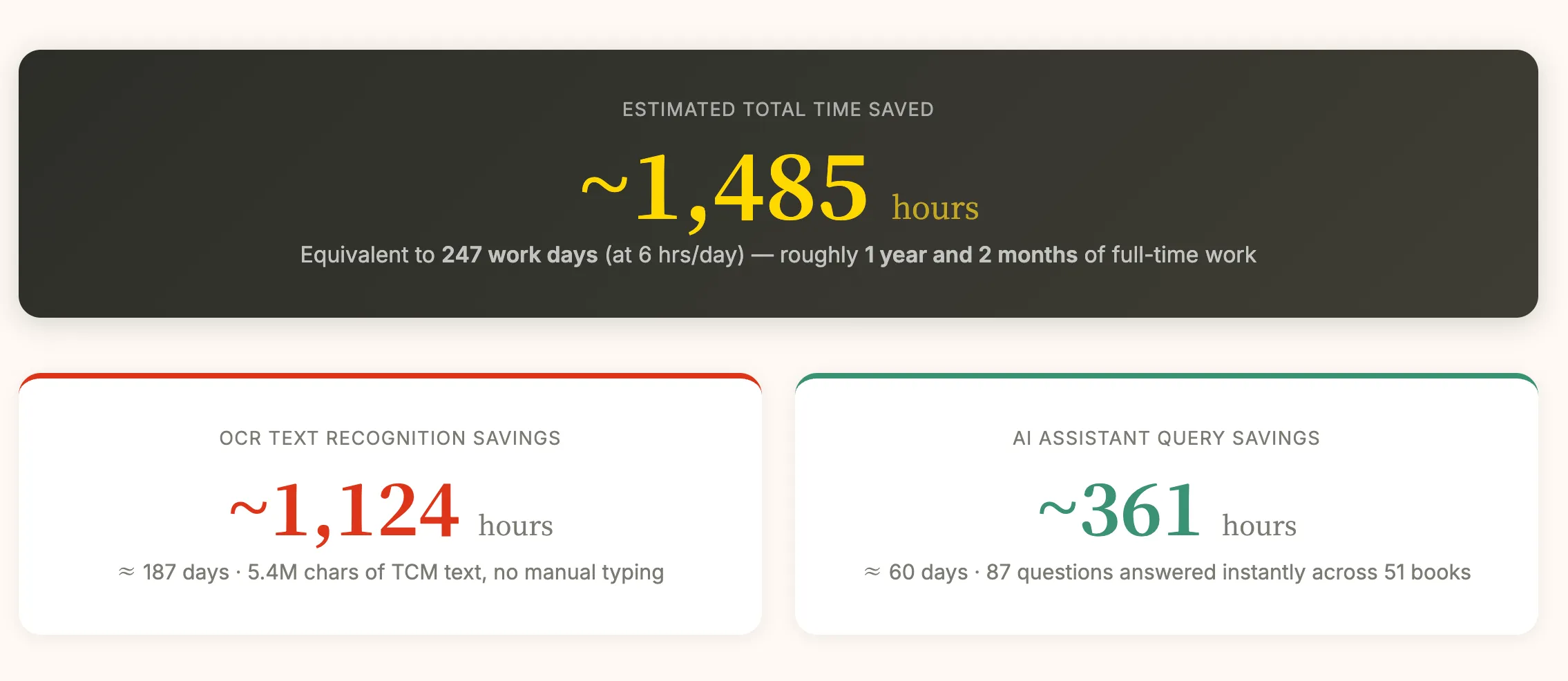
So far, it has processed 7000+ images, producing about 5.4 million Chinese characters of text across 50+ TCM books and notes. The AI assistant has answered 78 questions, most of which are about difficult symptoms that my father needs to think through further after seeing patients. My latest estimate is that it has saved my father about 1485 hours by not typing pages by hand, plus time saved searching and synthesizing across the notes.
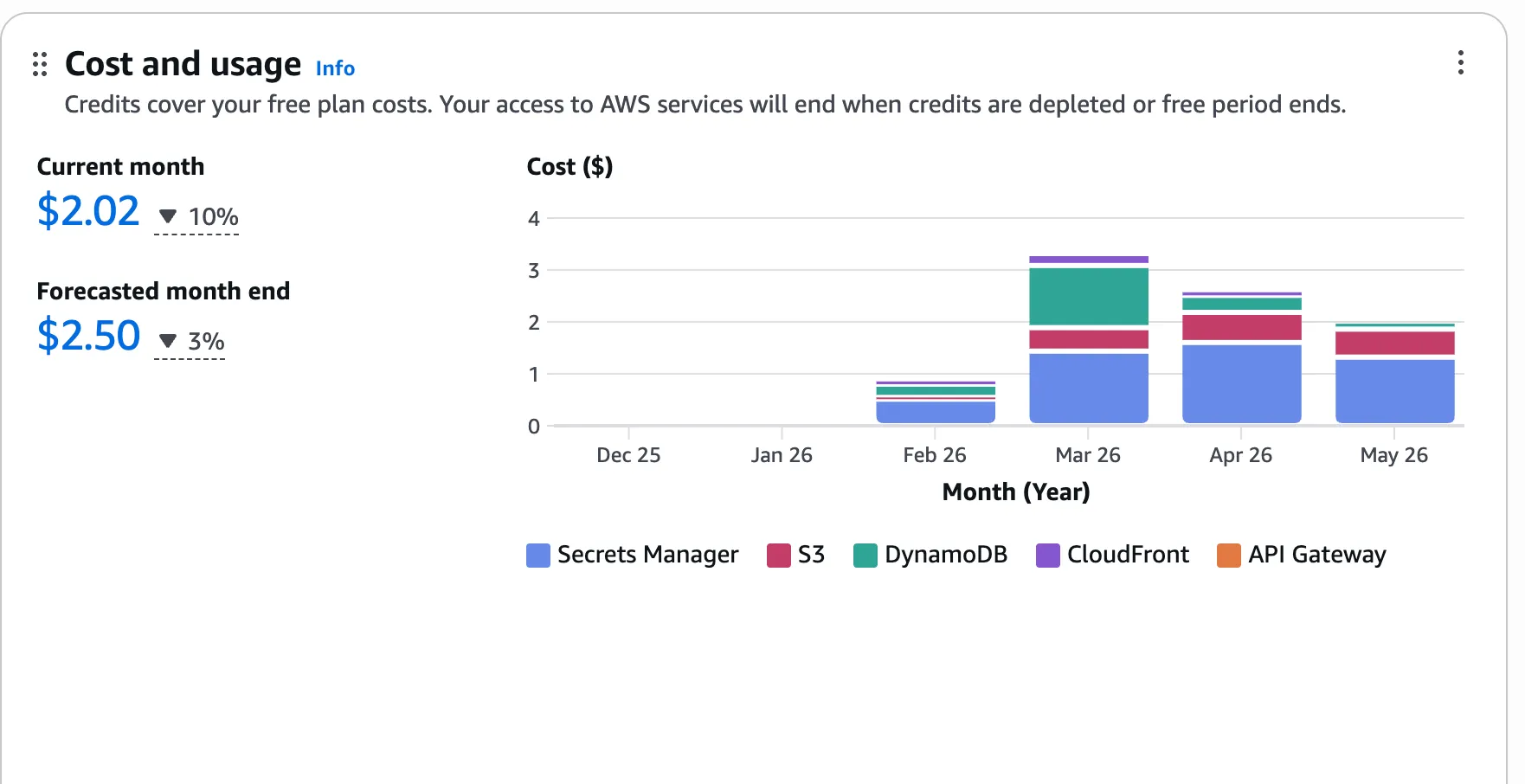
The fixed infra cost for running this app is <$3/month, and the rest comes from LLM usage at about ~$50/month. By my estimation, the Claude API cost of building this software is easily on the order of $2000 — probably exceeding the lifetime user-generated cost.
Sam Altman once said it is better to build something a small number of users love than something a lot of users like. For startups, “a small number” usually still means more than one. In this project, it was literally one doctor.
But that one doctor had decades of knowledge to digitize, and the pain point was acute enough that serious software was worth building.
That was the biggest lesson for me. AI agents do not just make existing software teams faster. They also lower the threshold for what is worth building at all. A year ago, I would not have built a full OCR pipeline, review queue, full-text search, assistant, citations layer, login flow, admin console, and deployment stack for one user. It would have sounded irrational. With the cost of building software dropping 100x compared to a few years ago, now it feels like the right tool for the job.
This project also made me a better engineer. I learned more by building the unglamorous parts — file uploads, message queues, auth, full-text search, admin tools, observability — than I would have learned from my full-time job.
It also made me better at listening to users. My father is not a quiet QA department. If something is confusing, he tells me directly. Most product teams need The Mom Test. I had my dad.
I think more people will be building such “forward-deployed personal software.” Sit next to someone with real expertise, watch the cumbersome parts of their workflow, and build the tool that makes them faster.
Not all useful software needs to become a company. Some software only needs to make one expert dramatically better at their work.
For me, that expert was my father.
Happy Father’s Day.